Joie De Vivire, 1946 by Pablo Picasso
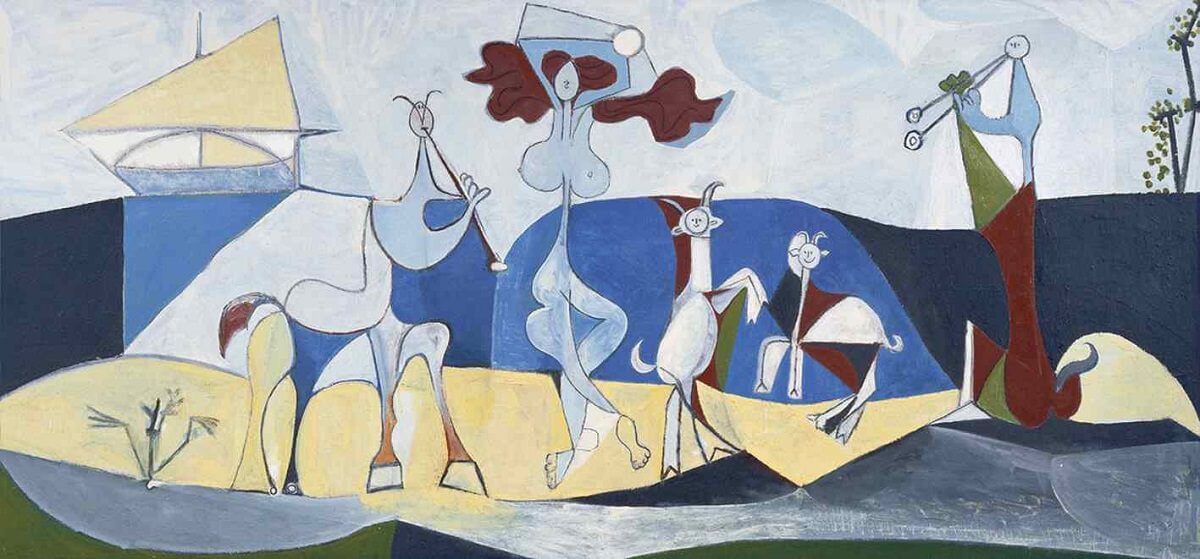
This work, obviously a parody of Henri Matisse's celebrated work Bonheur de Vivre (1905-06), is often read as a celebration of peace. Henri Matisse lyrical work features nubile girls dancing and playing pipes in an idyllic setting as long, sensual curvaceous lines flow through the composition. Picasso's copy is more overtly mythological, featuring with pipe-playing fauns and dancing creatures. However, he captures Matisses's lyricism in the extended swirling lines of the figures, whose forms appear to grow organically like flowers moving upwards towards the Mediterranean sun.
Picasso had finally returned to his favored French Riviera to enjoy freedom from Occupation as well as burgeoning relationship with a young French artist, Francoise Gilot, whom he painted as a flower
in 1946. She is possibly the model for the central creature of this work, with its long flowing hair. The couple visited Matisse in Nice - it was probably Matisse's request to paint Francoise with green
hair that provoked Picasso to copy his rival's earlier work with this large 120 x250 cm oil on fibreboard.
Picasso, 65 years old, and age when most retire, was once more in love with a very young woman and full of creative fervor. Francoise, 25, found she was pregnant shortly after this work was finished.