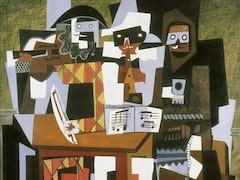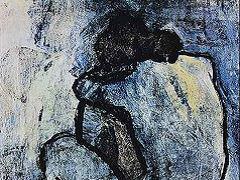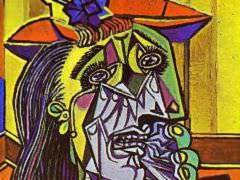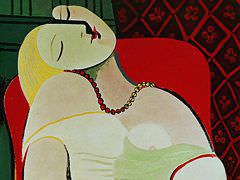
Neoclassicism and Surrealism Period - 1918 to 1945
In the period following the upheaval of World War I, Picasso produced work in a neoclassical style. In February 1917, Picasso made his first trip to Italy. He saw the celebrated collections of antique sculptures in the Vatican and the archaeological museum in Naples, and he looked at a lot of Roman painting and mosaics in Pompeii, Herculaneum and also in the Naples museum. He saw a great deal of Renaissance art both in Florence and Rome, the Primitives as well as Raphael and Michelangelo. In St Peter's he would have seen not only Michelangelo's Pieta but numerous sculptures by Bernini, and he must have looked at Bernini's extraordinary obelisk-bearing elephant and Michelangelo's Risen Christ in the Church of Santa Maria sopra Minerva because these were on the doorstep of the Minerva Hotel where Ansermet, Olga and the other dancers were lodging. The memory of Bernini's Roman fountains surfaced later in various set designs. Meanwhile his later damning references to Caravaggio - 'your enemy', Kahnweiler called him - suggest that he also spent time looking at the Caravaggio in Rome. All this 'high' culture was leavened by Roman and Neapolitan popular art in debased forms of the Rococo, Romantic and Realist styles. Moreover, Picasso was seeing all this in the company of writers, composers and artists - the kind of company in which he always thrived and which always stimulated him.
The immense diversity of styles of art he was engaged in looking at aroused Picasso's competitive and cannibalistic instincts, and over the ensuing years memories of the art he had seen in Italy surfaced in his figurative paintings and drawings, although allusions to specific works are generally rare. What has been called his 'return to order' was not an intellectual decision dictated by the theoretical debates circulating in Paris. Rather, it was driven by his personal contact with works of art which were fresh to him, and by his delighted sense of discovery and recognition
In 1918, Olga and Picasso got married. The young couple moved to an apartment that occupied two floors at 23 Rue La Boétie, acquired servants, a chauffeur, and began to move in different social circles, no doubt due to Olga's influence. The chaotic get-togethers Picasso had with his artist friends gradually changed into formal receptions. Picasso's image of himself changed as well, and this was reflected in the more conventional style he adopted in his art and the way in which he consciously made use of artistic traditions and ceased to be provocative.
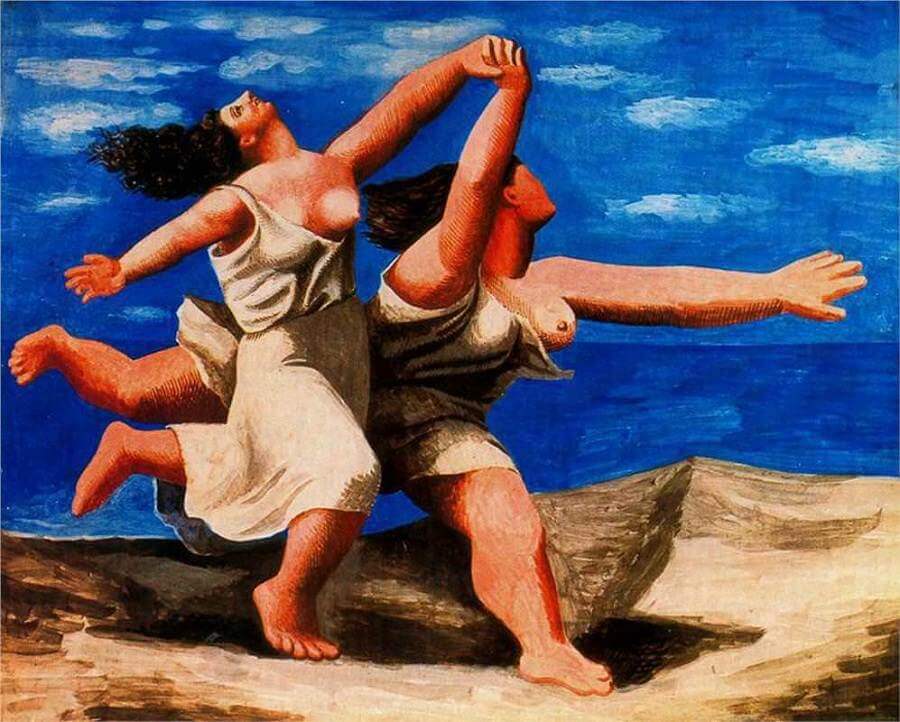
A typical example of this Neoclassicism style is Two Women Running on the Beach, Large Bather and Two Nudes.
In 1920s, influenced by the writings of psychologist Sigmund Freud, the literary, intellectual, and artistic movement called Surrealism sought a revolution against the constraints of the rational mind; and by extension, they saw the rules of a society as oppressive. Among the most popular Surrealism painters are Salvador Dali, Joan Miro and Rene Magritte. Surrealism also embraces a Marxist ideology that demands an orthodox approach to history as a product of the material interaction of collective interests, and many renowned Surrealism artists later on became 20th century Counterculture symbols, along with Marxist Che Guevara.
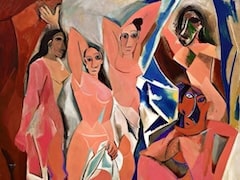
In 1925 the Surrealist writer and poet André Breton declared Picasso as 'one of ours' in his article Le Surréalisme et la peinture, published in Révolution surréaliste. Les Demoiselles d'Avignon was reproduced for the first time in Europe in the same issue. Yet Picasso exhibited Cubist works at the first Surrealist group exhibition in 1925; the concept of 'psychic automatism in its pure state' defined in the Manifeste du surréalisme never appealed to him entirely. He did at the time develop new imagery and formal syntax for expressing himself emotionally, a typical example is Three Dancers, 1925. But Surrealism only revived Picasso's attraction to primitivism and eroticism.